
The rise of Chinese chips! In 8 years, the localization rate of front-end equipment has increased by 425%
Recently, Japanese media released data showing China's self-sufficiency rate in chip equipment.
As shown in the figure below, the graph illustrates the changes in the localization rate of relevant equipment in 2017, 2021, and 2025.
It can be observed that the overall cost of the front-end process (referring to wafer manufacturing) increased from 4% in 2017 to 10% in 2021, and further to 21% in 2025. This represents a direct doubling compared to 2021 and a growth of 425% compared to 2017.
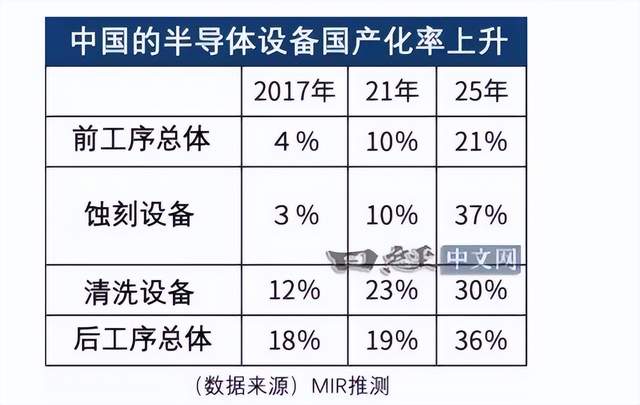
In the previous process, the localization rate of etching equipment is relatively high, reaching 37% in 2025, compared to only 3% eight years ago in 2017, which is equivalent to an increase of about 12 times.
The localization rate of cleaning equipment has also reached around 30%. However, this rate was already 12% in 2017, so relatively speaking, the growth rate is lower.
The overall proportion of the post-production processes (primarily referring to the packaging and testing stage) has increased from 18% in 2017 to 19% in 2021, and further to 36% in 2025, representing a doubling in just eight years.
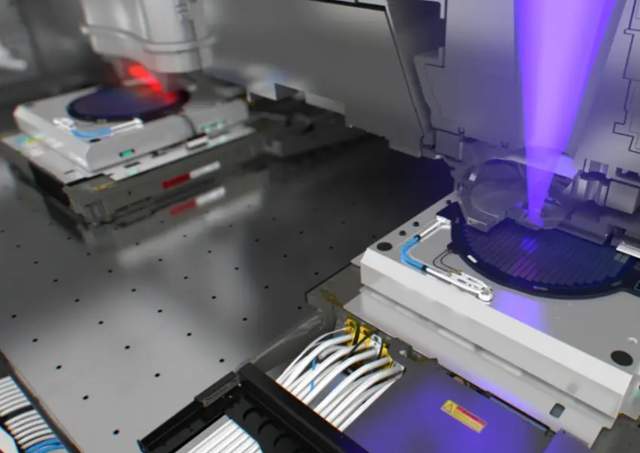
Correspondingly, Japan has also provided sales data of its semiconductor equipment companies to China. It is stated that over the past year or so, with the continuous improvement of domestic production rates of chip equipment in China, Japanese companies have reduced their shipments to China, especially front-end process equipment companies, such as JD Electronics, which have seen a significant decline.
In fact, this is not only the case for semiconductor equipment companies in Japan, but also for those in the United States and the Netherlands.
Take ASML as an example. In 2023, 2024, and 2025, its lithography machines were largely sold to the Chinese market, with China's contribution accounting for nearly 50% of the total. However, by 2026, this proportion had directly declined to 20%. This shows how dire the situation has become.
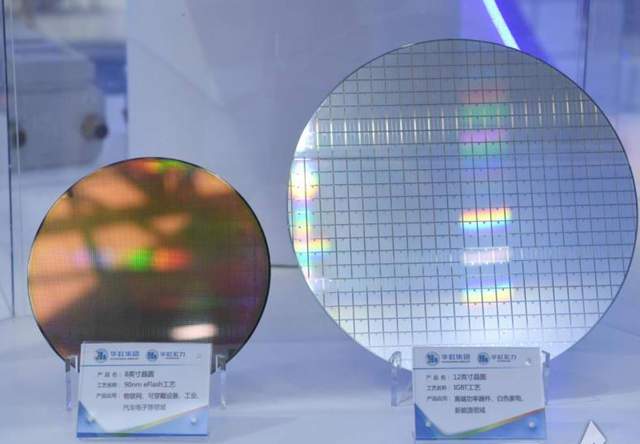
The same goes for American companies like Applied Materials, Corey, and Fanlin. In the past, over 40% of their revenue came from the Chinese market, as China purchased a large number of their equipment to manufacture chips.
However, the Chinese market remains intact, and China's equipment purchases remain the highest globally. However, imports from overseas have decreased as we have implemented domestic substitution. Domestic chip equipment companies are gradually taking market share away from overseas companies.
Why is it like this? Actually, it's all forced by the United States.
All along, the United States has been afraid of the rise of China's chip industry, and has joined forces with Japan and the Netherlands to contain China's chip industry by restricting the sale of various advanced chip equipment to China.
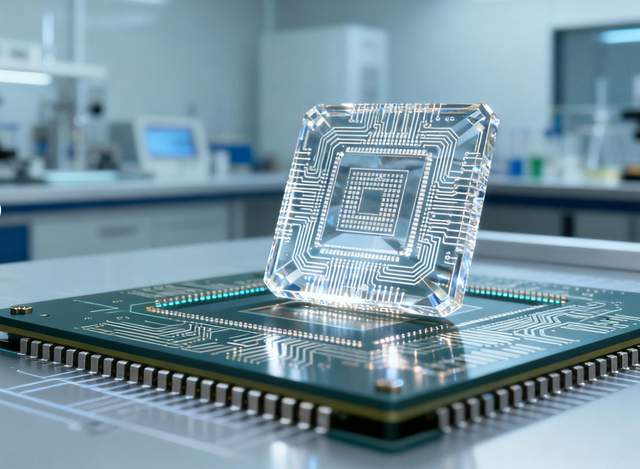
This is certainly intolerable, so domestic wafer fabs have joined forces with domestic supply chains to pursue domestic substitution. They started with substituting mature process technologies, such as 45nm and 28nm, and then gradually expanded to include 14nm, 7nm, and other processes.
Starting with non-core equipment substitution, and gradually moving on to core equipment, more and more wafer fabs are beginning to use domestically produced equipment. Everyone understands that the initial stage may be a bit challenging, but as long as everyone supports it, the evolution of domestically produced equipment will accelerate in the future. This will enable more and better domestic substitution in the future, so we won't be afraid of being held back by foreign countries.
I guess the United States never expected that the more sanctions they imposed, the more it forced China to accelerate its localization process, ultimately leading to China's independence from them. Is this not like lifting a rock only to drop it on one's own toes?
mail:wuping@csc-ic.com ; angel@csc-ic.com

right 2023. Chinaic Technology Co. ,Ltd. All Rights Reserved 粤ICP备13001812号
